AI providers
ARGUS uses one AI provider at a time. You can configure several and switch between them without a restart.
Go to Settings → AI providers.
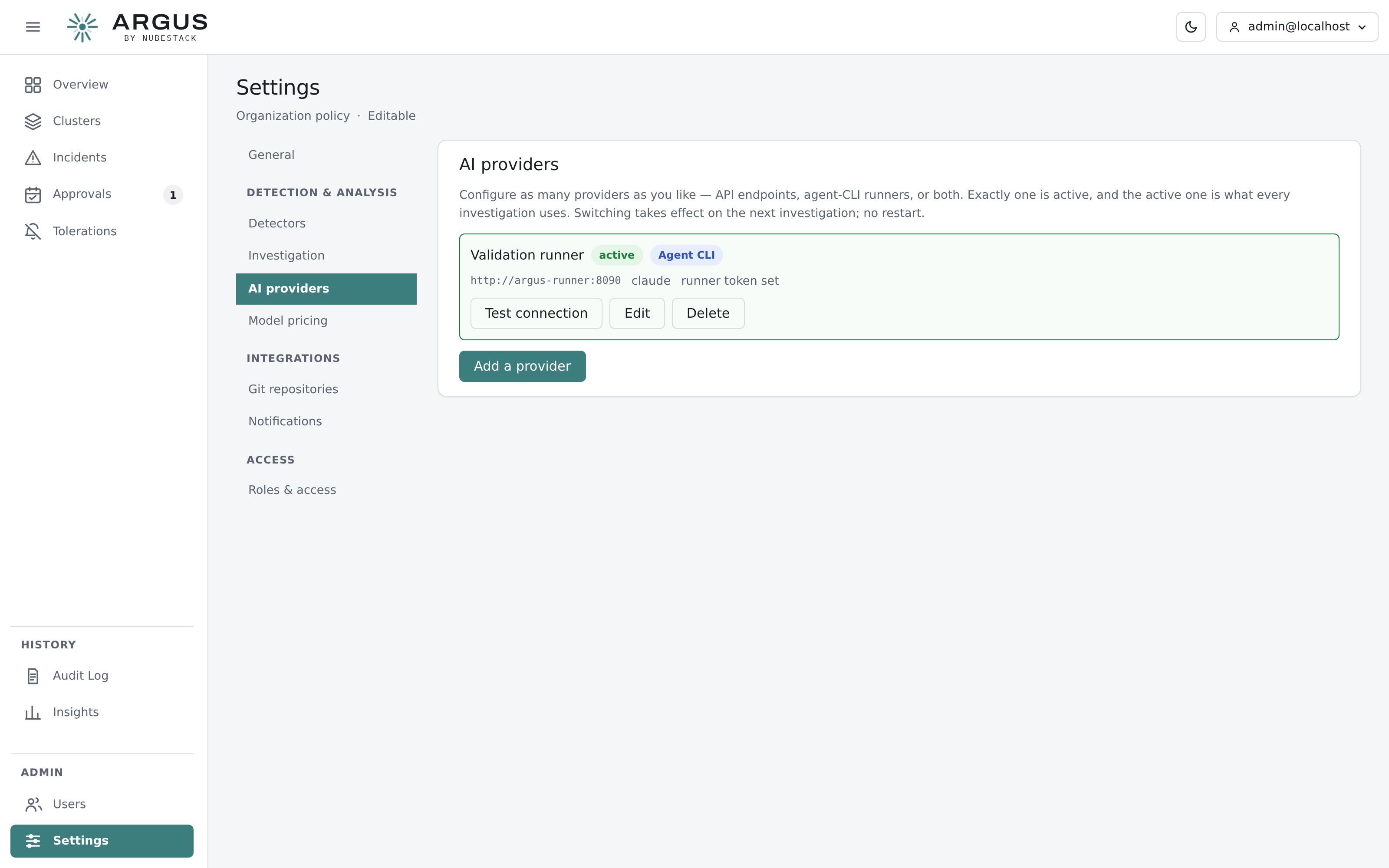
Exactly one provider is active. Switching takes effect on the next investigation.
Two kinds
| Kind | What it is |
|---|---|
| API endpoint | Any OpenAI-compatible endpoint — a hosted service, or a model you run yourself |
| Agent CLI | An isolated runner container beside the hub, driving an agent CLI |
API endpoint
| Field | Notes |
|---|---|
| Base URL | The endpoint. A self-hosted model is configured here like any other |
| Model | The model name exactly as the provider expects it |
| API key | Stored encrypted |
Agent CLI
| Field | Notes |
|---|---|
| Runner URL | The runner service beside the hub |
| Agent | Which CLI the runner drives |
| Runner token | The shared token the runner expects |
Test before switching
Test connection verifies the endpoint, the credential and the model. A failure names the reason, which is easier to act on now than as a failed investigation later.
Choosing a model
Investigation quality depends on the model more than on any setting. The loop is tool-based and iterative, so two properties matter: reliable tool-calling, and enough context to hold several object descriptions and log extracts at once.
A small model will produce investigations that stop early or propose actions that do not match their evidence.
Switching
Switching the active provider affects the next investigation. Analyses already recorded keep the model they were produced with, so a change in provider is visible in the history rather than rewriting it.
What is sent
Incident context and the results of read-only tool calls, with redaction already applied inside the cluster. No cluster credentials are ever included, and the model cannot execute anything — it proposes, and a typed, signed, rehearsed path executes. See Security model.