Tolerations
A toleration stops an accepted condition on one object from opening a new incident every time its detector re-fires. Use it when the fault is real, understood and being lived with.
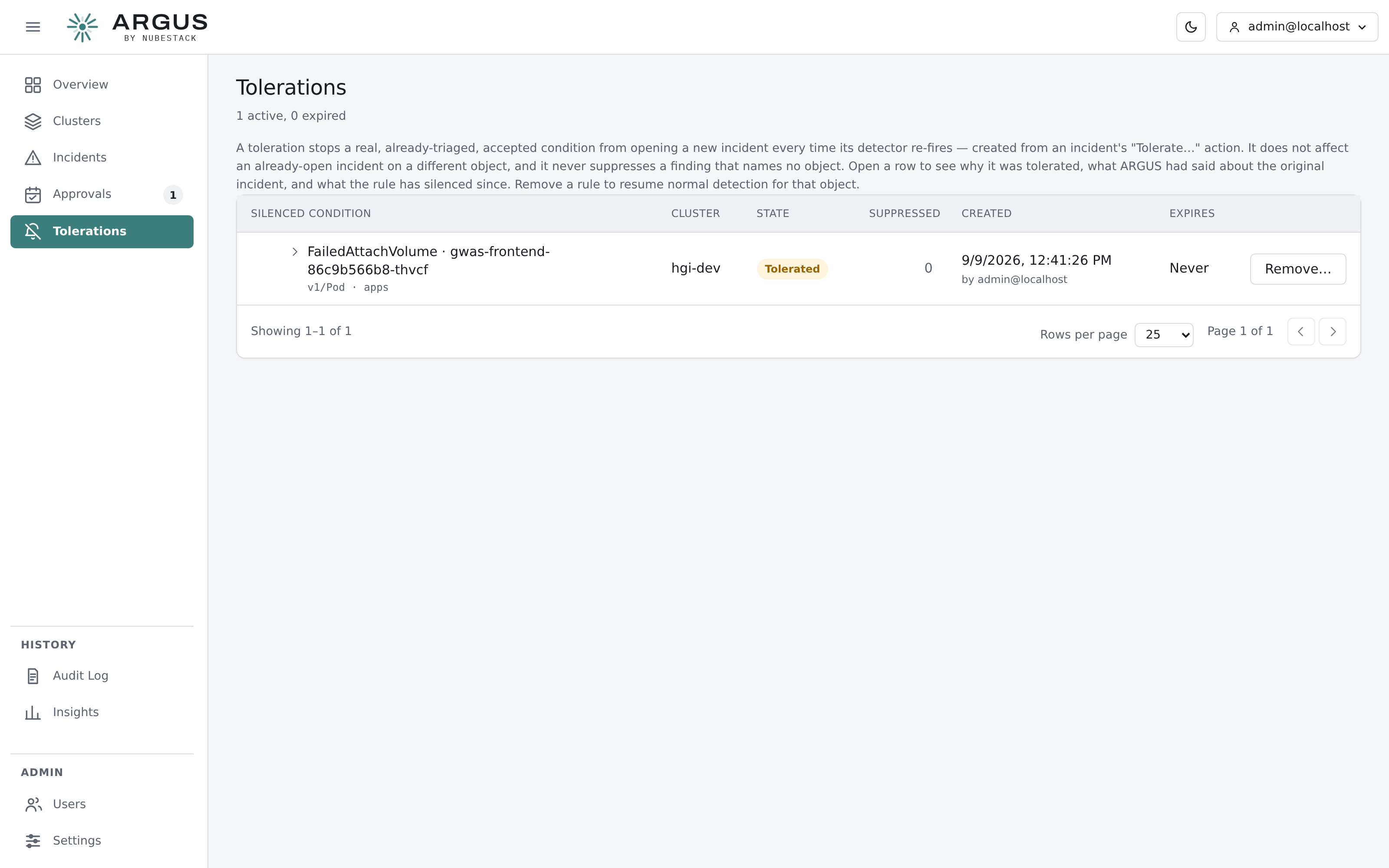
Each row is one silenced condition on one object. The suppressed count shows what the rule has actually stopped since it was created.
When to use one
Closing incidents repeatedly for the same known condition is a sign you want a toleration. Typical cases: a volume that cannot attach because of a known storage limitation, a deprecated workload nobody will fix before it is retired, a third-party component that logs a warning condition by design.
Tolerations are for accepted faults. If a condition is merely noisy across the whole fleet rather than accepted on one object, disable the rule instead — see Detector settings.
Creating one
Tolerations are created from the incident they apply to, using its Tolerate action. That is deliberate: a toleration is a decision about a specific object made with the incident's evidence in front of you, and the incident it came from is recorded with it.
You can set an expiry, so a toleration for a fault being fixed next quarter stops silencing it afterwards.
What it does and does not cover
| Does | Does not |
|---|---|
| Stops that condition on that object opening new incidents | Affect an incident already open on a different object |
| Records what it has suppressed, and how much | Suppress a finding that names no object |
| Keeps the original incident's evidence for context | Stop the agent detecting or reporting the condition |
The agent keeps detecting and reporting. The findings remain in the cluster's history, so the fault stays visible as data even while it stays out of the incident queue.
Reviewing them
Open a row on the Tolerations page to see why it was tolerated, what ARGUS had concluded about the original incident, and what the rule has silenced since.
Review the list periodically. A toleration with a large suppressed count is either doing exactly its job or hiding something that has grown worse; the original analysis is there to help you tell which.
Removing a rule resumes normal detection for that object immediately.