Resolution routes
Before ARGUS proposes anything, it decides where a fix for that object belongs. The decision is made in ordinary code from the cluster's own facts, and it constrains what the AI model is allowed to propose.
The four routes
| Route | Meaning |
|---|---|
| Pull request | The object's desired state lives in a repository. The fix belongs there |
| In place | Nothing manages the object declaratively. A live change is durable |
| Pull request and in place | Both are needed: recover now, and make it stick |
| Guidance | No automatic action is appropriate. ARGUS explains instead |
The route appears as a badge at the top of every incident, with one sentence saying why it was chosen.
Why code decides, not the model
If a GitOps controller owns an object, patching the cluster directly is reverted at the next sync. An operator who does not know that will conclude the fix failed.
So the route is computed from facts, not inferred: who owns the object, whether anything applies the repository, and whether the source is editable. Having decided, ARGUS offers the model only the action shapes that route permits — the model chooses what to change, never where.
| Route | Actions the model may propose |
|---|---|
| Pull request | Open a pull request, or delete an object |
| In place | Scale, restart, patch limits, revert an image, delete, annotate, label, create |
| Pull request and in place | Both sets |
| Guidance | None |
Guidance is a result
Most faults route to guidance, and that is the honest answer rather than a shortfall. A certificate that needs reissuing outside Kubernetes, a container image that must be rebuilt, a storage class that does not exist in this cluster — none is fixable by changing an object, and proposing a change would be wrong.
On a guidance route the recommendation card carries the concrete manual steps from the investigation: a real command with the real namespace and object name, or a named field and the value it should hold.
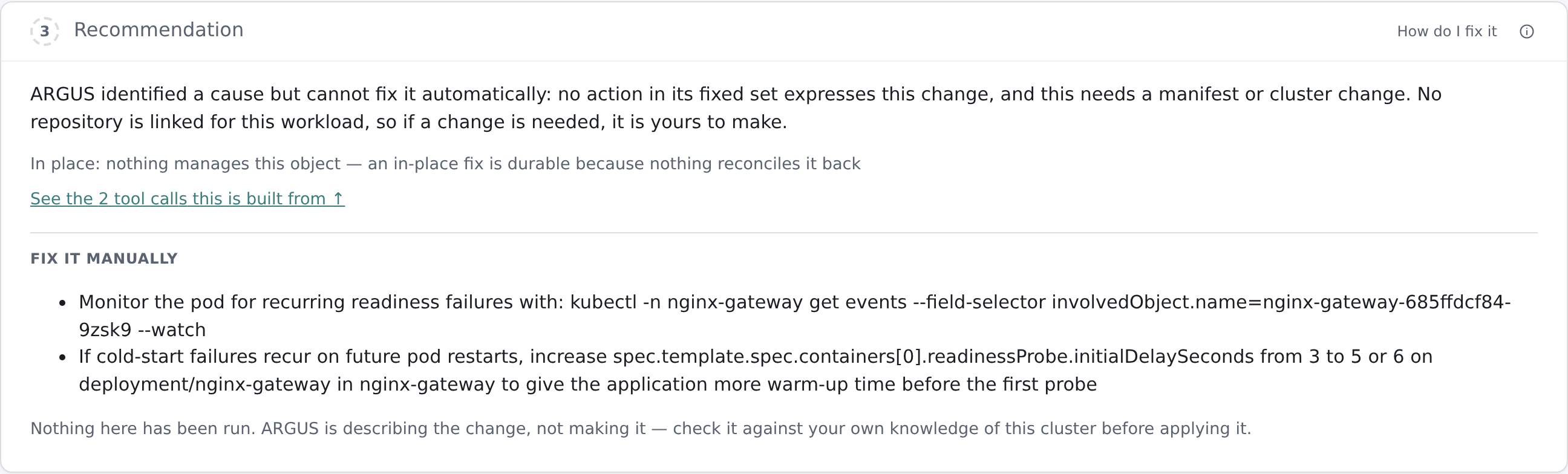
A guidance route. The card states there is nothing to execute and gives the steps a person would take, rather than presenting an empty plan.
Seeing both channels
Where a fix is proposed, the recommendation card shows both channels — repository and live cluster — each with its own availability.
An unavailable channel says why rather than disappearing: no GitOps controller reports owning the object, the controller reports no synced commit, or the controller reports a branch rather than a resolved commit so the running commit is not known.
The pull-request channel leads, and the live-cluster channel carries its consequence: on a managed object, a live change is reverted at the next reconcile. Both are shown because recovering now and fixing the source are different decisions.
Helm releases
A Helm release has no in-cluster object naming the repository it came from, the way an Argo CD Application or a Flux Kustomization does. So ARGUS knows a Helm release owns the object but cannot resolve a repository for it from the cluster alone.
When that happens, the incident offers to link the release to a registered repository, with the match ARGUS has proven by rendering the chart. Confirming it once covers every object that release owns.