Audit log
The audit log is the record of every consequential action, hash-chained so that a removed or altered entry is detectable.
Reading it requires super-admin. It is one of the two things only that role can do.
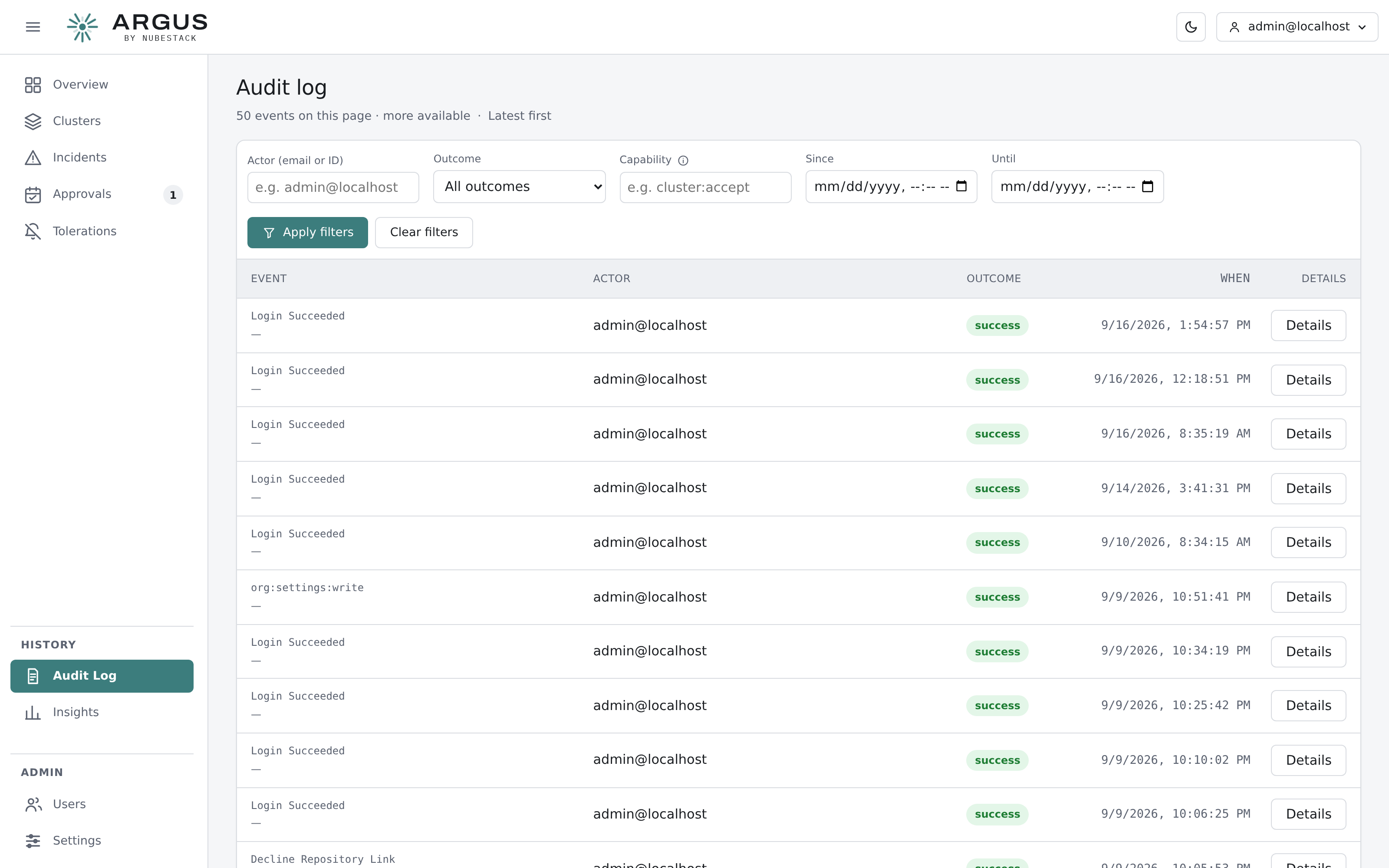
Each entry records who did what, to which object, with which capability, and whether it succeeded.
What is recorded
| Area | Examples |
|---|---|
| Access | Sign-ins, failures, token issuance |
| Incidents | Investigations started, incidents resolved, dismissed or tolerated |
| Remediation | Approvals and rejections with their reasons, executions and outcomes, rollbacks |
| Clusters | Enrolment, acceptance, rejection, archiving, remediation scope changes |
| Configuration | Settings changes, provider changes, repository registration |
| People | Account creation, role grants and removals |
Each entry records the actor, how they authenticated, the source address, the capability used and the outcome — including failures. A refused action is as much a record as a permitted one.
The hash chain
Entries are chained: each carries a hash covering its own content and the entry before it. Deleting or editing one breaks the chain from that point on, which is detectable.
The chain can be verified independently of the hub, directly against the database, so a verification does not depend on the software whose records are being checked.
Filtering
Filter by actor, capability, cluster, outcome and time range. The common questions — who approved this, what changed on this cluster last week, what has this account done — are each one filter.
Unattended executions
An unattended execution is recorded exactly as an approved one is, with the gate's verdict and rationale in place of a person's decision. A change with no human in the loop is not a change with no record.
Retention
Audit retention is set independently of incidents and findings, under Settings → General. It defaults to keeping everything. Consider your own obligations before setting a window — see Data retention.