Signals
Signals lists every finding the agents have reported — the raw symptoms and risks underneath the incidents — and what ARGUS did with each. Use it to see what ARGUS noticed and did not raise.
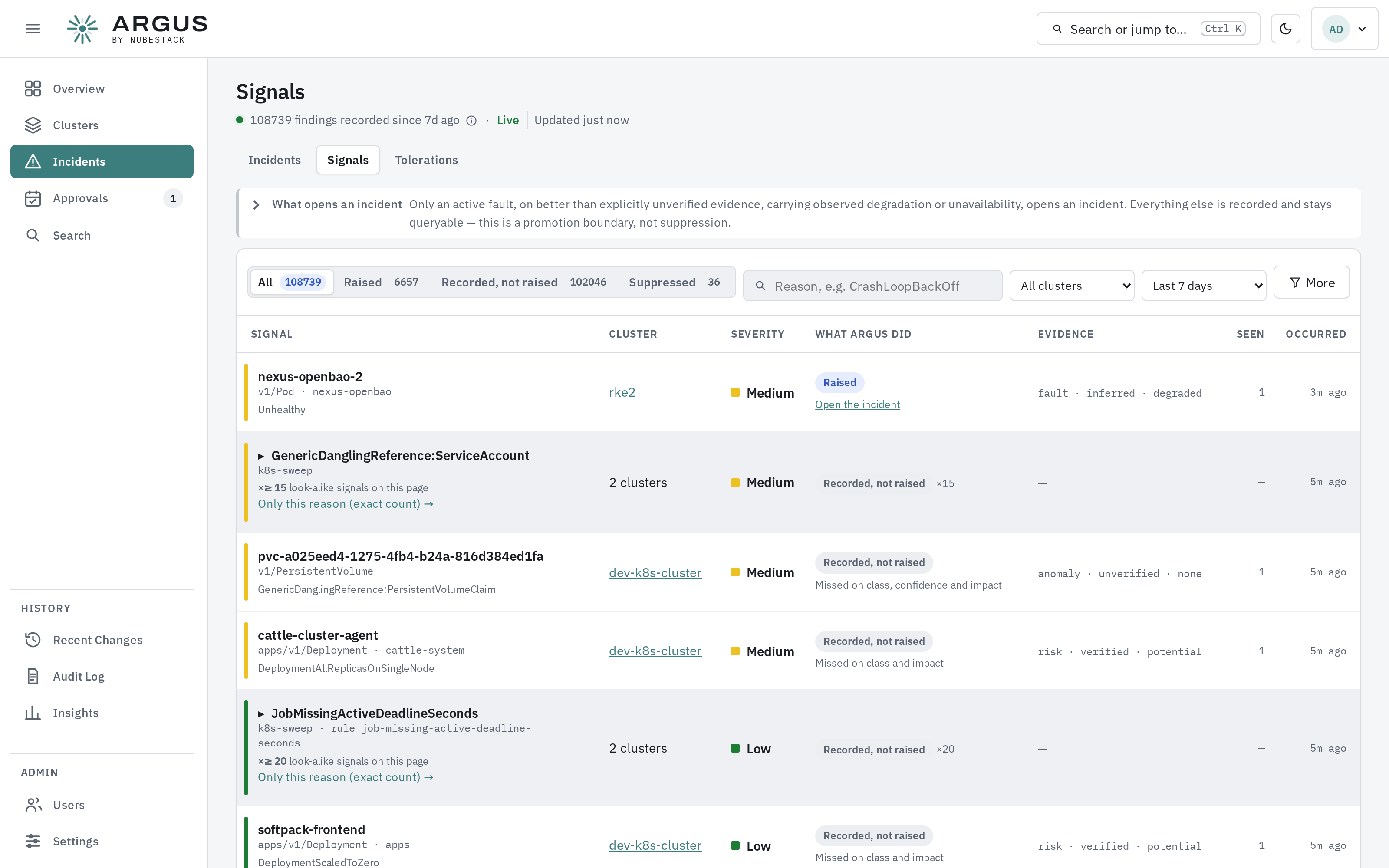
Each signal says whether it opened or joined an incident, and if not, why not.
What ARGUS did with a signal
| Tab | Meaning |
|---|---|
| Raised | The finding opened an incident or joined one |
| Recorded, not raised | Kept as evidence. It was a risk, rested on unverified evidence, or showed no harm yet |
| Suppressed | A toleration or storm protection kept it from raising, and the row says which |
| All | Every signal in the window |
What opens an incident, at the top of the page, states the rule: only an active fault, on better than unverified evidence, showing degradation or unavailability, opens an incident.
Reading a signal
Each row gives the object, the reason, the cluster and the severity, what ARGUS did and why, the evidence class — fault, risk or anomaly, its confidence and its impact — how many times it was seen, and when.
Look-alike signals on one page are grouped under their reason. Only this reason narrows the list to that reason across the whole window, with its exact count.
Filters
Search by reason, and narrow by cluster and time window. More holds further filters.